Albany WA April 20, 2015
We awoke to another day of full on sunshine - that's two in a row... I went for an early long walk on the beach, and still only got halfway along toward Emu Point.
We started our day at the Anzac Memorial, high on Mt Adelaide overlooking the harbour. To give you some background, This is the very harbour from which the 1st and 2nd convoys of Australian and New Zealand troops left for Gallipoli in 1914. Some 40,000 troops had been assembled on a whole pile of ships, and they complete with a bevy of warships, all gathered here in the harbour, right below this very point. High up here was also where the garrison and guns were housed in the Princess Royal Fortress, built in 1893, as part of the coastal defences for Australia.
 |
| Princess Royal Fortress. 1983. Albany WA |
Time moves on and now the whole place has been turned into a really nice park with museum pieces all around the place.
The National ANZAC Centre was opened on November 1, 2014 and so is relatively brand-new. It is not huge, but it is brilliantly set out and has lots of interaction for the visitor. It's just about WWI and so the content is quite focussed and quite detailed.
 |
| National ANZAC Centre. Albany WA |
When you go in, you are given a card with a picture of a soldier on it and a code on the back. You are also given a talking-pen thing.
But first, as you step through the first door, there is a full wall sized film running of a continuous stream of soldiers marching up the street and past you (actual footage) and it is reflected in a mirror on the other side of the hallway. All the while there is a solemn march beat of boots crunching along in time with the marchers. Its pretty powerful right from the start.
As you walk around, you swipe the pen on special markers and listen to the commentary. When you come across special posts, you place your card down on them and a big screen comes up showing all the actual documents for that person, and so you follow their progress through the war and ultimately discover their fate. This is interspersed with stunning and quite personal displayed of individuals and each ones involvement, along with a visual and audio commentary of the process and detail of the war as it played out in the various theatres. One room has full sized windows overlooking the harbour, and the walls have panoramic photos of the assembled convoys: you look at the photos and you look at the harbour. You just can't help but immediately relate the two and once again, that personal touch is there: these were real men and it really happened, right here. The picture I took was of this wire-frame horse and soldier
 |
| National ANZAC Centre. Albany WA |
In another gallery, with the same stunning view, the centre piece is a narrow, full length glass table. Under the glass are the names of every individual, one above the other. The list slowly moves forward toward the window and the visual link is made that they are going, one by one, from here, out to their waiting ships in the harbour, and to war.
 |
Judy wondering about her grandfather and his departure to war
National ANZAC Centre. Albany WA |
I think they have achieved the objective of making it personal, and in doing so, making the history at least believable to the future generations. Lets hope they take some notice. Lest we forget indeed
Both our soldiers, one Australian and one Turkish, Ottoman as they called them, survived, although badly wounded several times.
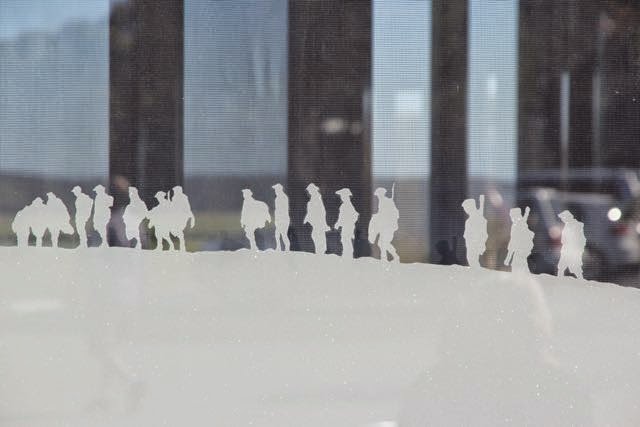
The Garrison Cafe outside had these very relevant etched windows
 |
| Garrison Cafe. Albany WA |
Outside, we walked uphill toward the viewing platform. We stopped to snap some old chimneys but got this shot of a black lizard instead.
 |
| Lizard. Albany WA |
We explored the old fort, very similar to others see have visited around the country, but were sidetracked by the view from the topmost viewing platform. We sat for at least 45 minutes watching the Pilot and two tug-boats escort a huge cargo ship out of the harbour, and then bring another one, that had been swinging-at-picks, into her berth. As you can see the red and green channel markers don't leave a lot of room for error.
 |
| Cargo ship being piloted into port. Albany WA |
After a light lunch in town we wandered into St Johns Church, built in 1849 to have a look at the site at which the first ever ANZAC dawn service was held, in 1930. You can see that the ties to the ANZAC legend runs deep in this town
 |
| St Johns Church. Albany WA |
 |
| St Johns Church. Albany WA |
 |
| Original gas candle-sticks. St Johns Church. Albany WA |
Many years ago, when dinosaurs roamed the earth and Judy and I were but youngsters, we came here on a visit from Perth. One of the things we both remember is going to a disused whaling station and poking around. We think that this is now called Discovery Bay, a preserved, one-time fully operational whaling station. We took ourselves out there and went happily into the reception / shop area ready to go and look-see. But no! These little scamps wanted $30 - yes THIRTY, dollars per head - yes each, to go in. That's sixty bucks. Time for a reality check - we could eat out for that, we could stay 2 nights in a van park for that - no way - no how, so we left, but not before using the loos.
As a consolation prize, we took a detour to Salmon Holes Beach, reputed to be a place where the Australian Salmon come to breed and feed. OMG, we were treated to the sight no less than 5 giant stingrays rounding up the salmon, who you can see clearly in the waves, and on the hooks of the fisher-persons.
 |
| Stingray on Salmon Holes Beach. Albany WA |
 |
| Rock fisherman. Salmon Holes Beach. Albany WA |
 |
| Stingray on Salmon Holes Beach. Albany WA |
|
 |
| Stingray herding salmon on Salmon Holes Beach. Albany WA |
Look again carefully at those same fisher persons on the rocks. This is Monday. Just two days ago, on Saturday, two fishos were swept off those very rocks - at this time they have retrieved one body. This southern ocean is renown for being able to produce a huge wave without notice, and have massive seas -on Saturday they had 7 metre swells. So, lets all go down and fish from the rocks... I think not.
Enough fun for 1 day. Retire to van and drink cider and eat tater crisps before having homemade pizza for dinner.
To put Albany into perspective, while we were having dinner, the TV was going on about Bonaparte and Waterloo and how he was defeated in 1815 and we all think this happened soooo long ago, ancient history almost. Albany, this little town way down here in Terra Australis, thousands of miles from any civilisation, was, and I quote from the web...
On the 9th of November 1826, Major Edmund Lockyer, together with a contingent of convicts, soldiers, a surgeon and storekeeper, left Sydney aboard the 'Amity' bound for King George III Sound. The Amity arrived on Christmas Day 1826. Lockyer selected the site of what is now known as Albany for the crown and thus formed the first Western Australian settlement. Major Lockyer named his new town 'Frederickstown', after King George III's second son, His Royal Highness Prince Frederick Augustus, Duke of York and Albany - 'The Grand Old Duke Of York'. Albany was settled some three years before the Swan River colony, later to be known as Perth.
I


